
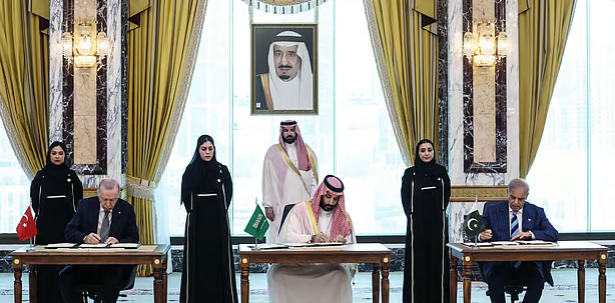
Saudi Crown Prince Mohammed bin Salman (centre), Turkish President Recep Tayyip Erdoğan (left) and Pakistani Prime Minister Shehbaz Sharif signing the joint defence agreement. 7 August 2026, Mecca. Photo: AFP
Amid rising tensions in the Middle East triggered by US and Israeli aggression against Iran, Saudi Arabia, Pakistan and Turkey have signed a joint defence agreement.
Known as the “Mecca Joint Defence Pact”, the agreement was signed yesterday (Friday) in the holy city of Mecca, Saudi Arabia. Turkish President Recep Tayyip Erdoğan, Saudi Crown Prince Mohammed bin Salman and Pakistani Prime Minister Shehbaz Sharif signed it.
The partners jointly stated that an armed attack on any one of the three countries would be considered an attack on all. This clause means they will build collective defence against any aggression.
Pakistan’s Foreign Ministry said in a separate statement that the signed joint defence agreement is “based on the long-standing historical relations, enduring bonds of brotherhood and Islamic solidarity among the three countries.” It will further strengthen their mutual strategic interests and long-standing defence cooperation.
The statement added that the agreement reflects the three countries’ mutual commitment to further consolidate their collective security for a safe and prosperous future, and to strengthen peace, security and stability in the Middle East and beyond.
Pakistani Prime Minister Shehbaz Sharif arrived in Saudi Arabia accompanied by Army Chief Field Marshal Asim Munir. The agreement emerged the day after they performed Umrah in holy Mecca.
Turkish President Recep Tayyip Erdoğan also visited Saudi Arabia on Friday to meet Saudi Crown Prince Mohammed bin Salman.
Why this agreement now?
Discussions on a defence agreement among Ankara, Riyadh and Islamabad had been ongoing for some time. Talks began soon after the 7 October 2023 Hamas attack on Israel and the subsequent Israeli genocide in Gaza. They gained further momentum after the start of US and Israeli aggression against Iran.
Although Turkey and Pakistan have not been directly affected by Middle East tensions so far, Saudi Arabia (due to US military bases and infrastructure in the country) has faced attacks from Iran and its ally, Yemen’s Houthis. Tehran has also attacked US military bases and related interests in other Gulf countries and Jordan.
All three countries are particularly concerned about the aggression against Iran and Israel’s growing influence and attacks in the region. Israel has occupied nearly one-fifth of Lebanon, citing the need to target bases of the Iran-backed Lebanese armed group Hezbollah.
There have also been allegations of drone attacks on Saudi Arabia by Iran-backed groups in Iraq. These groups themselves have been targeted by US and Israeli strikes.
Rasul Sardar of Al Jazeera from Ankara said that, according to officials there, growing regional tensions are the main reason these countries have come under one umbrella.
The Al Jazeera journalist said: “Since 7 October 2023, the situation in the region has changed dramatically due to Israeli aggression and their expansionist policies. And now we are seeing a crisis in the Strait of Hormuz, ongoing attacks on Iran, and Iran’s response toward regional countries.”
Rasul Sardar added that several layers of demand have converged in this situation, forcing these three major countries to sign the agreement together.
On 19 March this year, during an Islamic summit in Riyadh, the foreign ministers of Turkey, Pakistan and Saudi Arabia met and discussed what a joint security agreement might look like.
Before that meeting, in September 2025, Pakistan and Saudi Arabia had signed a bilateral defence agreement. That agreement was signed shortly after an Israeli attack in Doha, the capital of Qatar, on 9 September 2025.
Özgür Ünlühisarcıklı, Managing Director of the South and Southeast Europe Office of the German Marshall Fund of the United States and Regional Director for Turkey, told Al Jazeera that this defence agreement reflects the loss of confidence in the current security system and the growing desire for greater regional strategic autonomy.
Özgür said: “All three countries share a similar state-centric view of regional stability. Despite differences of opinion, they see a strong central government, territorial integrity and effective state institutions as the foundation of order. Similarly, they view state fragmentation, internal conflict and the empowerment of non-state actors as sources of long-term instability.”
What will this agreement achieve?
The trilateral agreement is believed to build on an existing agreement already in force between Ankara and Islamabad. Analysts say it will combine the military and financial strengths of each country. Turkey has NATO’s second-largest military, Saudi Arabia is the world’s top oil exporter, and Pakistan is the only Muslim nuclear-armed country.
Özgür said the three partner countries bring complementary strengths: Turkey’s defence-industry capabilities, Saudi financial power and influence, and Pakistan’s military experience and strategic deterrence capacity.
He added that it should be remembered this is a framework for close strategic, military and defence-industry coordination among three influential regional powers, not a mutual defence treaty comparable to NATO.
Murat Aslan, Associate Professor of International Politics at Hasan Kalyoncu University in Gaziantep, Turkey, told Al Jazeera that the agreement is also expected to include “capacity-building” elements.
Aslan said: “We know that for decades Saudi Arabia has been dependent especially on the United States for its defence equipment, weapons or machinery. We also know this is expensive. Saudi Arabia needs to develop its own defence sector internally.”
The professor added: “Turkey and Saudi Arabia share two issues—first, Iran. You can also add Pakistan’s name… they have a border. The Saudis have a huge fear in their minds. Their fear is that Iran could affect their security. So this agreement will somehow consolidate their security.”
Osama bin Javed of Al Jazeera from Doha said the agreement essentially brings together the three largest Muslim populations under a joint peace framework so that any aggression against them can be deterred. They can maintain coordination with each other on intelligence sharing and increase cooperation in other areas such as energy, defence spending and production.
Osama said these three countries together have now created a force that, especially in the context of the Iran war, could push the region toward a different framework from the conventional security architecture of the past few decades.
What is Iran’s reaction to this agreement?
No official statement has yet come from Iran’s leadership. However, Iranian parliamentarian Ibrahim Rezaei criticised the agreement in a post on X (formerly Twitter) on Friday.
Rezaei wrote: “The Saudis should know that a paper agreement with Turkey and Pakistan will not bring them security, just as unilateral dependence on the United States has not been able to provide them security all these years.”
He further wrote: “Correct your own policies so that you do not have to beg others for security.”
What does this agreement mean for Israel?
So far, neither the office of Israeli Prime Minister Benjamin Netanyahu nor the Israeli Foreign Ministry has commented on the new defence agreement among Saudi Arabia, Turkey and Pakistan.
On Friday, a Turkish official told Reuters that the agreement among the three countries is primarily defensive in nature and is not directed against any specific country. It is also open to other regional countries.
However, it is clear that all three countries were particularly concerned about Israel’s influence in the region and the recent increase in attacks.
In early July, while speaking alongside Pakistan’s Sharif in Istanbul, Turkish President Recep Tayyip Erdoğan said that efforts for peace in the Middle East would not succeed without regional support. Israel should not be allowed to “sabotage” the US-Iran agreement.
Erdoğan further said: “We are closely monitoring the Israeli administration’s efforts to sabotage the (US-Iran) agreement. We cannot allow the current warmongering Israeli government to again plunge our lands into the smell of gunpowder and blood.”
The Turkish leader has repeatedly accused Israel of attempting to nullify the US-Iran memorandum of understanding signed on 17 June to stop the war and create space for negotiations.
Erdoğan has also condemned Israeli attacks in Gaza, Lebanon and Syria.
Pakistan has strongly condemned Israel’s ethnic cleansing in Gaza. More than 73,000 Palestinians have been killed in Gaza in Israel’s brutal and indiscriminate attacks since October 2023, most of them children and women. More than 1,000 people have been killed since the US-mediated ceasefire announced last year. Pakistan has also opposed any idea of a so-called “Greater Israel.”
However, Pakistan has been playing a mediating role in the Iran war with the US and Israel to avoid a regional war.
US President Donald Trump has long hoped to normalise relations between Israel and Muslim countries by having Saudi Arabia sign the so-called “Abraham Accords.” But Saudi Arabia has repeatedly strongly condemned Israel’s actions in Gaza and the occupied West Bank.
Saudi Arabia has insisted that it will not normalise relations with Israel until there is a clear path to the establishment of a Palestinian state. However, the warmongering and extreme Zionist Netanyahu government is strongly opposed to a Palestinian state.
Yasmine Farouk, Project Director for the Gulf and Arabian Peninsula at the International Crisis Group, wrote in a 20 July report that closer defence relations among Turkey, Pakistan, Saudi Arabia and Egypt reflect the realistic understanding of these four countries.
These countries realise that the security of their neighbours can no longer be left to the hostility between the US and Israel on one side and Iran on the other.
Farouk said many officials from these countries had reached this conclusion even before the US and Israel launched their aggression against Iran in late February. But the war and Iran’s subsequent retaliatory attacks—including missile and drone strikes on Gulf Arab states and the closure of the Strait of Hormuz—have given new momentum to this process.
However, Farouk noted that several Israeli and American commentators and officials have portrayed these countries’ joint security agreements as “an anti-Israel or anti-Israel/UAE Sunni axis.”
At a conference in Jerusalem in February this year, former Israeli Prime Minister Naftali Bennett claimed that Turkey is the “new Iran” and that Ankara is trying to incite Saudi Arabia against Israel and is building a hostile Sunni axis with Pakistan.
Source: Al Jazeera (via Prothom Alo)
 Iran-Israel Tensions Escalate as Trump-Backed Ceasefire Faces Fresh Challenges
 US Senate passes Russia sanctions bill, threatens 100% tariffs on India and China
 Trump Says Iran’s Supreme Leader “Should Be Very Worried
 Diane Keaton Cause of Death: Friends Reveal Sudden Weight Loss Before Her Passing
 Iran Open to Nuclear Deal Compromises if US Discusses Lifting Sanctions
 Live World Cup Football 2022 Live Streaming
 Shooting at Pawtucket Ice Rink Leaves Multiple Victims, Heavy Police Response
 Angel Reese Becomes the First Athlete to Walk the Victoria’s Secret Runway
 5 Common Reasons Why You Can’t Sleep and Their Simple Solutions
 Six Nations 2026: Wales Name Louis Rees-Zammit at Full-Back for England Opener
 Tragic End in Search for Lil Jon’s Son: Body Recovered from Pond
 War Widow Moves Husband’s Grave to Kyiv Fearing Russian Occupation

News | Health | Sport | TV | Privacy Policy
Read World Popular Newspaper- Indian | Bangladeshi
All rights reserved © 2026 liveworld24.com